“Check Your Balls” Campaign: How Urologists and the Sporting Community Are Changing Attitudes Towards Men’s Health
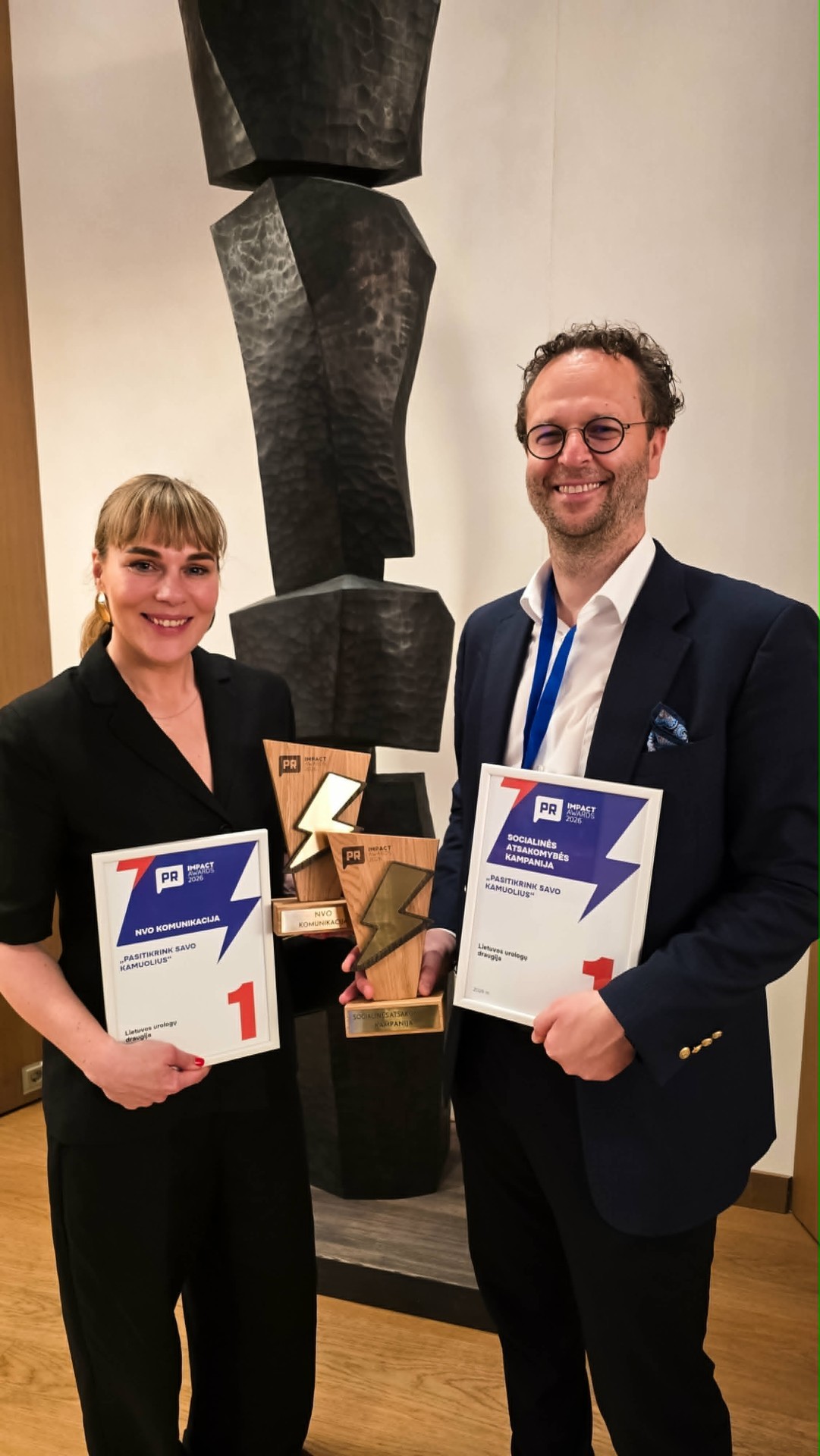
Today, the success of a social awareness campaign is measured not only by how it looks, but also by the changes it brings about in people's behaviour. Over the past few years, “Check Your Balls” has become a recognisable men's health initiative in Lithuania. The project, which won first place in the NGO category at the PR Impact Awards 2024 (in partnership with the Lithuanian Basketball League), received awards in the Best NGO Communications and Corporate Social Responsibility categories at this year's PR Impact Awards 2026 for its 2025 initiative (in partnership with the Lithuanian Golf Federation). In 2024, the Lithuanian State Patent Bureau also recognised it as the most innovative registered trademark of the year, and it was selected as a Business Favourite. This year, the initiative is being implemented together with Parateam and the National Goalball Federation.
At the final ceremony of the PR Impact Awards, held on 5 June this year, the creators of more than 50 projects and their partners were recognised, alongside other awards celebrating achievements important to the communications community. A total of 170 project applications were submitted to this year's competition.
We spoke with project manager Indrė Ereminė about how partnerships between medical professionals and sporting communities help reach male audiences, challenge stereotypes surrounding sexual health, overcome the challenges of communicating sensitive topics and turn public awareness into meaningful action.
“Check Your Balls” has received several significant communications and brand awards over the past three years. What do you think makes this initiative successful?
I believe creativity is important when addressing this subject, but it is certainly not the most important factor. Men's cancers are an important and highly relevant topic, but our objective has never been simply to create a visible campaign. The fundamental challenge is reaching an audience that often does not see itself as the intended recipient of this message. This is particularly true when it comes to testicular cancer, which most commonly affects young men. They often assume that “this has nothing to do with me”. That is why the creative solutions behind the initiative are a means to an end: a way to attract attention and encourage conversation, rather than an objective in themselves.
I also believe that, in social initiatives, what matters increasingly is not just the launch of a campaign, but its ability to remain relevant over time. It should not be a one-off project, but a consistent, long-term commitment. The involvement of a strong medical community is particularly significant in this respect. Prostate and testicular cancer are addressed by a urological organisation and specialists who deal with these diseases directly in their daily practice. This gives the message additional weight and credibility. There are relatively few consistent, educational communications projects of this kind initiated by medical organisations. This also makes the format distinctive within the broader field of healthcare communication.
Another very important aspect is feedback from real life. We hear stories of people who, after seeing the campaign, became more attentive to their health, underwent examinations, consulted urologists and were diagnosed at an early stage of the disease. As the campaign's main active phase takes place every April, urologists themselves notice an increase in patient numbers following the campaign – people who have sought medical attention specifically after encountering its message.
Success stories are shared both by people who have recovered and by patients who are still undergoing treatment. For us, this is one of the most important indicators that the message is reaching its intended audience and genuinely contributing to earlier diagnosis and better treatment outcomes.
At the same time, only a very small proportion of men are willing to share their personal stories publicly. This also demonstrates that these subjects remain taboo in society and that there is a real need to talk about them. Sexual health is still an uncomfortable subject for many people, often accompanied by embarrassment or silence, even though the number of prostate cancer cases remains high.
It is therefore not easy to approach this subject or find creative solutions that present it tastefully and without vulgarity, while still attracting attention and maintaining relevance. It is encouraging to see that we are gradually building the confidence of our partners, who are willing to help spread the message and demonstrate that men's sexual health and cancer can be discussed with dignity, sensitivity and humour, while encouraging changes in habits that support better health.
How do you measure the success of an initiative like this?
Views and reach are important, but they are not the primary objective. What matters most to me is whether someone takes action after encountering the campaign: visits the website, reads information about self-examination, discusses the subject with family members or consults a doctor. In health communication, the real result begins when behaviour changes.
Alongside this, I increasingly recognise a less visible measure of success: whether the subject becomes easier to discuss and whether people become more comfortable with creative approaches to these topics in public spaces. Sometimes the greatest change is not reflected in numbers, but simply in the fact that a conversation is taking place at all.
When the embarrassment surrounding uncomfortable and less appealing subjects begins to diminish, more room opens up for dialogue, discussion and action. Of course, recognition at the PR Impact Awards and other professional competitions, where projects are assessed by industry experts, is also an important acknowledgement, an opportunity to evaluate our work and an encouragement to continue developing the initiative.
What was the main problem that “Check Your Balls” set out to address from the very beginning?
The problem was that young men often do not feel a personal connection to the subject. Testicular cancer seems like a distant concern, even though this is precisely the age group most commonly affected by the disease.
This illustrates a typical challenge in modern communication: the issue is not a lack of knowledge, but a lack of perceived relevance. Even when information is available, it has little impact if people cannot recognise themselves in it. We therefore needed to find a way to make medical information relevant to young men.
More broadly, when it comes to cancer, early diagnosis is particularly important. The earlier a disease is detected, the greater the chances of successful treatment and the better the quality of life following treatment. The campaign aims to encourage men to become accustomed to noticing changes in their bodies through self-examination and to seek medical advice in a timely manner. It also encourages participation in Lithuania's Prostate Cancer Early Detection Prevention Programme.
Challenging stereotypes of masculinity is another key objective of the campaign. The belief still persists that taking care of one's health, consulting a doctor as soon as symptoms appear or discussing sexual health is somehow “unmanly”. Various stereotypes surrounding visits to urologists also remain deeply rooted in society.
That is why last year's campaign slogan, “Hard Isn't Always Good”, was chosen deliberately. It works as a metaphor both for one of the possible symptoms of testicular cancer and for deeply ingrained perceptions of masculinity that often encourage men to ignore health problems and postpone seeking medical help.
How did you manage to communicate about cancer in a way that made the message heard without compromising medical accuracy?
Humour is not an objective in itself in this initiative. An unexpected format or a phrase that brings a smile may make someone stop and pay attention, but it is the content – the core message – that must hold their interest.
I believe the campaign's message first and foremost makes people pause amid the constant flow of information and react. This is largely influenced by the emotionally engaging campaign name, the distinctive logo, the visual language and clear associations with the subject. The involvement of professional athletes and the medical community is also significant, helping the message reach a broader male audience.
What does it mean to create a national campaign within the NGO sector?
It means using the resources available to you very responsibly. NGOs often cannot compete in terms of budgets, so they have to compete through ideas, partnerships and people's belief in what they are doing. This makes every partnership and every person who joins the initiative particularly valuable.
Personally, I feel a strong connection to socially sensitive issues. This is where I see great purpose: helping people pause amid the noise, information overload and relentless pace of everyday life, and turn their attention to the genuinely important, fundamental issues that surround us every day but that we are often unwilling or reluctant to notice.
What is more difficult: coming up with a creative idea or finding partners? What challenges do you face in developing this annual initiative?
A good idea can be developed, but when you are addressing men's sexual health or cancer, an idea alone is not enough. You need people and organisations willing to stand publicly alongside the subject. This requires trust, a sensitive understanding of the topic and a different approach to making the case than in conventional negotiations.
I am grateful to the partners who trust us and join the initiative – to everyone who has contributed their time, their face and their support, both in front of and behind the camera, helping us spread the message.
To date, we have developed projects with the Lithuanian Basketball League, the Lithuanian Golf Federation, Parateam and the National Goalball Federation. Professional sporting communities help communicate a meaningful message and reach male audiences.
When approaching sporting communities, influencers or well-known personalities with an invitation to join a campaign addressing men's intimate health and cancer, the response does not always come quickly, nor is it always positive.
Topics like these require more than a good creative solution. Every year, we have to find new ways to remain original, explore fresh perspectives and arguments, while preserving the initiative's underlying purpose.
I am grateful to the Lithuanian Urological Society for giving me the freedom to create and develop this project. Cancer, sexual health and stereotypes are not easy subjects. Yet it is precisely where trust and creative freedom exist that the greatest value and the best results emerge.
How do you find the balance between humour and the seriousness of the subject?
I believe respect for the subject is essential when talking about cancer. However, when addressing sexual health, we use humour to reduce discomfort and open up the conversation.
Having worked on this initiative over the years, what insight about Lithuanian men has proved most significant or even somewhat unexpected to you?
Working with the Lithuanian Urological Society, I have come to see that the main problem when it comes to men's health is not indifference. More often, it is procrastination. Some men do take care of their health, but they need regular reminders, encouragement, clear guidance, structure and motivation to take action.
Why has “Check Your Balls” remained relevant for three consecutive years?
Because every year we look for a new creative way to address the same problem without changing its fundamental message. We believe that changing behaviour and habits takes time, consistency and continuous communication.
These subjects also present considerable creative challenges: how to discuss them without vulgarity, accurately and in a way that captures attention quickly; how to remain relevant, avoid repetition and preserve originality.
Partners, sporting communities and creative formats may change, but the objective remains the same: to encourage men to pay attention to their health earlier, seek medical advice in a timely manner and take care of themselves consistently throughout the year, rather than only when a health problem has already progressed.
© 1996–2026 Lithuanian Urological Society
Lietuvos urologų draugija
Santariškių g. 2, Vilnius
Juridinio asmens kodas 191933163
El. paštas info@lud.lt
Teisinė forma: asociacija